

SGS Action Plan 2026: Switzerland's digital foundation becomes reality
The action plan 2026 is more than just a list of projects: it is the roadmap for a smart, data-driven Switzerland. By pooling resources in SWISSGEO and proactively addressing the shortage of skilled workers, the Swiss Geoinformation Strategy (SGS) ensures that geoinformation can be used as a strategic resource and added value.
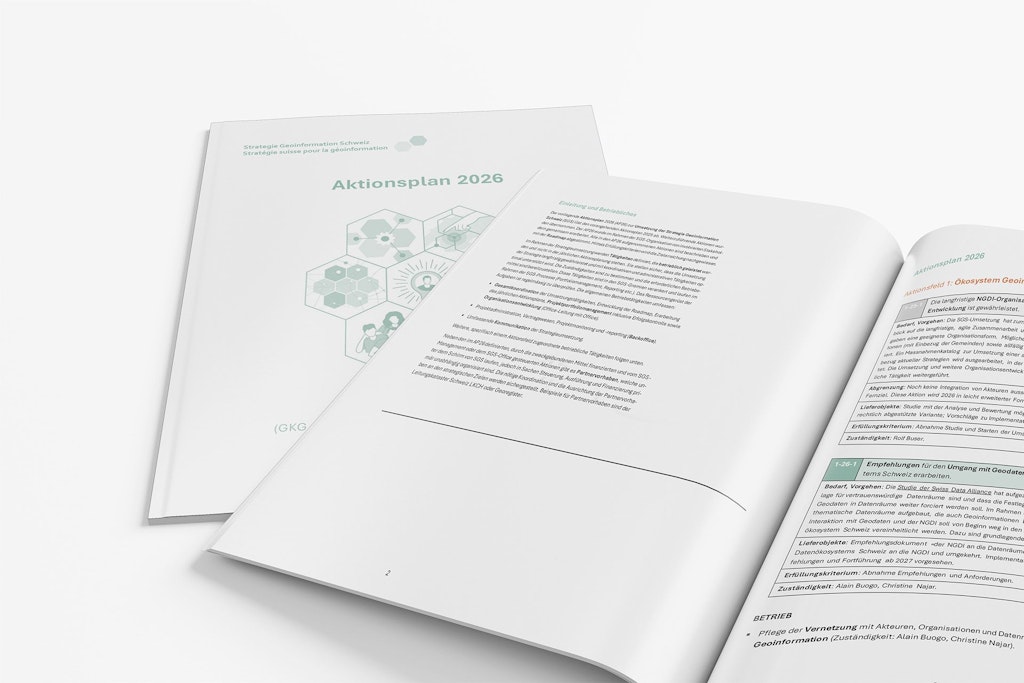
The action plan 2026 will take the National Spatial Data Infrastructure (NSDI) to its next phase. The launch of the first version of the new national geoplatform SWISSGEO, the targeted use of AI and groundbreaking steps in the field of GeoBIM mark the transition from concept to productive impact. While legal hurdles to seamless data harmonisation are being removed, the industry is actively addressing the shortage of skilled workers with a concrete catalogue of measures. Today, we are building the data infrastructure that will enable sustainable decisions tomorrow.
Platform evolution
In 2026, the core component will be implemented with the launch of SWISSGEO. The first version of SWISSGEO makes geodata from geo.admin.ch and geodienste.ch available in one place for the first time. The existing platforms geo.admin.ch, geocat.ch and geodienste.ch will continue to operate in parallel for the time being.
- Objective: The aim is to provide user-centred access for the administration, the economy and the population.
- Focus: Creation of a transition plan and a product roadmap for the gradual integration of all geodata (including Cadastral Survey data).
Innovation and technology
Switzerland is consolidating its role as an innovation hub for geodata:
- Generative AI & LLM: Following the prototyping phase in 2025, the focus in 2026 will shift to validating risk reductions and the long-term implementation of semantic search.
- GeoBIM: The digitalisation of the construction industry will be driven forward by closing gaps in the process chain between geoinformation and building information modelling (BIM).
- Anticipatech: The innovation process is operationalised in order to translate technological trends (technology radar) directly into strategy implementation.
Harmonisation and law
The legal basis (GeoIG/GeoIV) is being reviewed in order to speed up the flow of data.
- Data harmonisation: clarification of tasks and responsibilities between the federal government and the cantons in order to achieve a comprehensive, needs-based harmonisation (geometric, semantic).
- Sustainability: Development of implementation guidelines for the long-term availability of geodata.
Competencies and ecosystem
- Skills shortage: Based on the analysis of 2025, a catalogue of measures will be implemented. At least two priority measures (e.g. marketing, training profiles) will be launched in 2026.
- Governance: The organisation of the NSDI will be made more agile in order to ensure long-term cooperation between the federal government, cantons and municipalities.
Read the full action plan below:
- Geoinformation.ch: Swiss Geoinformation Strategy - Action plan 2026 (in German or French)
- Geoinformation.ch: Swiss Geoinformation Strategy - Action plans since 2022